When I was five, we had cottages on a white sand beach on a tidal creek in Scarborough, Maine. We had a dock and an 18-foot Lyman Morse boat with a mahogany deck, trim, and seats. Every Saturday in the summer, we went out to Richmond’s Island off Cape Elizabeth. Five-year-old’s are not expected to understand anything, but I absorbed everything visually because it was a new world.
On most of our boat trips, we went to Clam Cove on Richmond Island. Back in the 1950s, there were four-foot logs piled high along the high tide line of the beach on the island. The ends of the logs were painted red, orange, yellow, green, and blue. I didn’t know why. I was a five-year-old; I didn’t have to know why. I don’t remember asking about them, and I don’t believe I even wondered about the color or why there were hundreds of four-foot logs piled on the beach of the cove. Mixed in were lobster buoys, rope, and old wooden lobster traps. In those days, five-year-old’s were free to roam like cats and dogs, and I accepted everything in the world as I saw it.
I remember, back then, my dad navigating the boat and moving at low power to avoid hitting logs floating in the water. Logs in the 1950s were a natural hazard. We had a ten-horsepower motor and went slowly to avoid damage. The ocean hazards of the 1950s are still vivid in my memory. We even had logs with painted ends that washed up on our beach, but nothing like the numbers that piled up on the islands.
Where the Logs Came From
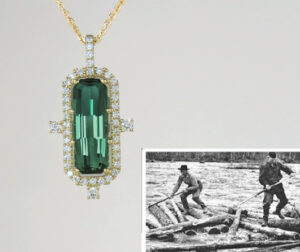
As an adult, I now know that years back, paper companies harvested trees in Maine forests along our large rivers. There were many companies that cut trees and limbed branches for the paper companies. They were cut into 4-foot lengths, and then the ends were painted to know to whom they belonged. They would throw the painted logs into the river and let the logs drift to the sea. Before the logs arrived at the sea, they would fish them out. They did the same with bigger trees for lumber, and there were teams of guys who had an excellent sense of balance and steel-tipped prongs to guide and move the logs along to their appropriate destination, where they were finally fished out of the river.

These river loggers were so good that they could walk across a moving river on floating logs. I was in my fifties when I learned what the stone pilings were along the Kennebec River. They were catch basins for logs of various companies. The river guys would direct the painted logs into the appropriate basin.
This Maine tourmaline necklace is called the Maine Logger’s necklace, evoking the era of wood, pulp, and logs floating down our major rivers and being pulled ashore before reaching the sea. The design is magic, a long, lean green Maine tourmaline in a custom-made mounting with diamonds surrounding.
Why were there so many logs out on Richmond Island when I was a kid? Because spring, summer, and fall storms would sweep in and the loggers would not be able to work and some of the logs would wash out to sea.
Why We Love This Necklace
The necklace is grand. The tourmaline was mined in our western mountains, just 25 minutes north of Portland. The center gem is green, the color of spring and summer, and is surrounded by 41 high-white, natural earth-mined, ideal-cut diamonds. The diamonds are the sparkly light on the water. This is a powerful symbol of the State of Maine.