Damariscotta’s Oyster Bay
And the Thousand-Year Party
It was the biggest party the Maine coast had ever seen. Thousands came every summer. It was wild. June, July, and August, full sun, two tides a day, a full moon every month.
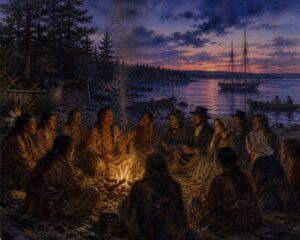
The Thousand Year Party
There was dancing. There was conversation. There was fine dining and bonfires late into the night. It wasn’t just weekends because weekends wouldn’t be invented for two thousand years. It was every night. There were tests of strength. There was competition. There were even fights between tribes because everyone in their teens and twenties was looking for a mate.
There was hunting that thinned out into the forests that surrounded what someday would become Damariscotta and Newcastle, Oyster Bay, Damariscotta Falls, and the Damariscotta River. The party was wild. It was non-stop. There was fishing, swimming, diving, and then there was the lead item on the menu…oysters.
An Ancient Oyster Bar
This wasn’t J’s Oyster Bar on the waterfront in Portland. It was miles of ancient establishments and Stone Age encampments. It was like Burning Man for 90 days but better, and it went on every summer in fog, rain, or shine. How their early commerce worked, we have no idea. There were no coins or credit cards. Money wouldn’t be invented anywhere in the world for over a thousand years, and yet, the party went on every summer for a thousand years. It was never canceled, and in everyone’s lifetime, they made time to attend at least once…often, many times.
We have no idea of the details of what went on. How do we know about the thousand-year party? How do we know it ever occurred? What evidence do we have three thousand years later that the biggest, most successful gathering happened on this spot on the Maine coast? The proof was the Whaleback Shell Heap.
This was the largest shell heap ever found in Maine. Billions of oyster shells were piled on either side of the Damariscotta River above today’s town of Damariscotta. It was an astounding mountain of oyster shells piled up by diners and partygoers at the big event. The Whaleback Shell Heap was the evidence of the success of this oyster feast and this summer festival.
Now, the Archeologist Speaks
The Damariscotta, Newcastle, Maine shell Heaps were astounding for their size. The success of the party was clear even thousands of years later. Excavations have shown oyster shells approaching the size of dinner plates.
Chickens and a company in Boston were responsible for the disappearance of the mountain of shells called Whaleback. Chickens lay eggs. The shell of the egg is mostly calcium. To ensure strong eggs, chicken feed is often supplemented with finely ground ocean shells to reinforce a proper calcium intake for chickens. A Boston firm in the late 1800s saw a goldmine of shells at Whaleback. They paid a local landowner a sum and proceeded to mine the site.
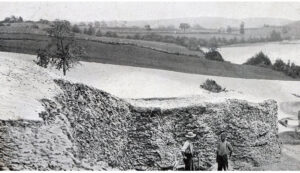
This is an old photo of mining shells at Whaleback.
The Boston company did such a good job mining. Today, you would never know this section of the Damariscotta River, as viewed from old Route 1 on the Damariscotta side, ever held this historic cash of oyster shells. The State of Maine purchased the land. There is a parking lot up along old Route 1 for 12 cars, and there are signs and pathways that lead down to the riverbank.
The signs explain the historical significance of Whaleback. The signs say nothing about the thousand-year party. At the river’s edge, you can see evidence of soil and shells. If you go to the far right, where the fields stop, and the forest begins, you can see more evidence of larger oyster shells mixed in with the underlying soil.
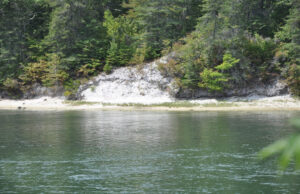
The Newcastle shell heap
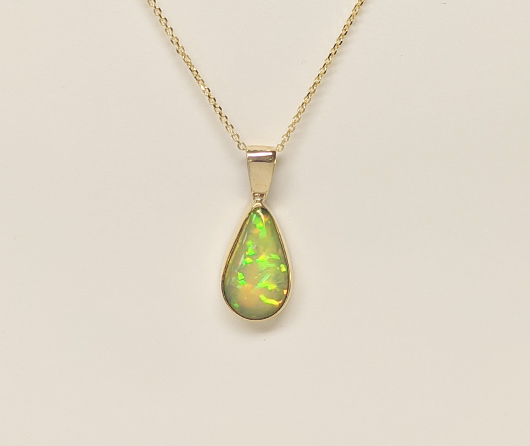
More telling of what Whaleback looked like 150 years ago is looking across the Damariscotta River to Newcastle because the white mounds of shells still spill out of the woods on the Newcastle side and reach down to the river’s edge. Looking upstream, above the new Route 1, is Great Salt Bay. This was called Oyster Bay three thousand years ago and is the basis for the name of our necklace and earrings.